
For years, deliverability was the key to a successful email marketing program. Get your domain authenticated, warm up your IP, clean up your list, follow sender best practices and your emails would reach the inbox.
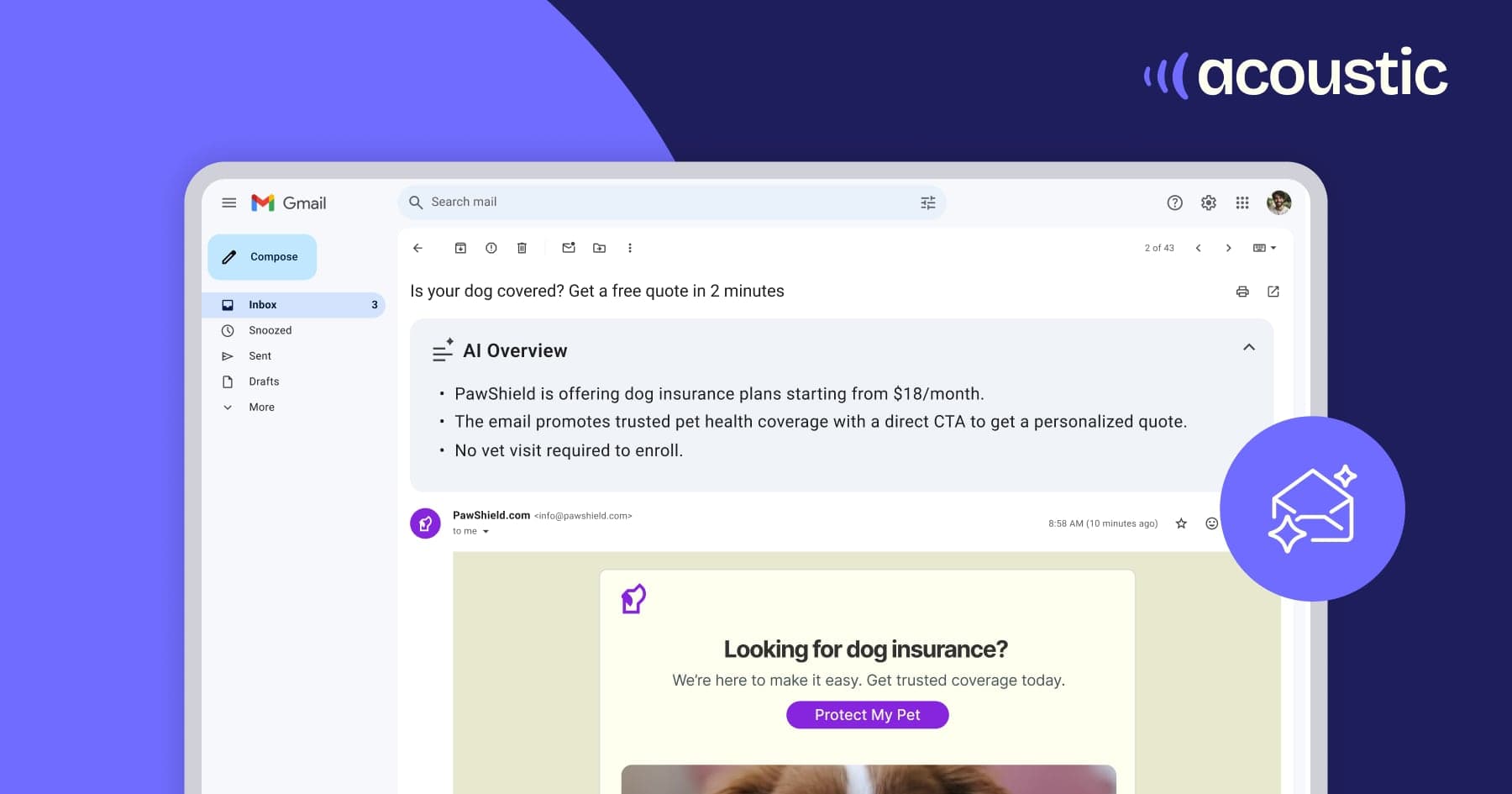
That's no longer true. Gmail and Yahoo are layering AI into the inbox experience — summarizing your emails, sorting them by predicted relevance, and deciding what deserves the recipient's attention before they ever open them. Getting delivered is step one, but getting seen depends on whether the algorithm thinks you're worth showing.
The game has shifted once more: From best practices to requirements, and now from requirements to relevance. And that changes everything — not just how you measure success, but how you structure your emails and whether the AI's summary of your message helps you or buries you.
Why deliverability alone isn't enough anymore
Make no mistake; authentication still matters. SPF, DKIM, DMARC — if you're not passing those checks, you're not even playing. But passing them doesn't mean you're winning, it means you're allowed to compete.
The inbox providers have moved on. They're now building behavioral profiles of your sender-recipient relationships based on per-user signals: How quickly someone deletes your emails, whether they scroll through or skim past, and how they've interacted with your brand over months of messages. It’s often referred to as "sender reputation," but it's really relevance scoring. And it's per-recipient, not universal.
It comes down to the fact that machine learning used by mailbox providers is getting better at detecting low-value, repetitive messaging — what deliverability teams call "promotions noise," thanks to these behavioral profiles. That means that erroneous batch-and-blast used to just be poor practice — now it’s actively penalized.
The result? Poor inbox placement, more frequent deferrals, or outright rejection. Not because your authentication failed, but because the algorithm decided your emails weren't relevant.
What's happening inside AI-powered inboxes
The inbox isn't a chronological list anymore. It's a curated feed. And AI isn’t just filtering your emails, it’s interpreting them.
Google Gemini previews and Gmail deal annotation cards can satisfy consumer interest without them ever opening your message. Yahoo's AI summaries do the same, automatically extracting some content and surfacing "just the important info" in a single line. The AI extracts the offer, the price, the deadline, etc. — and displays it directly in the inbox view. If the summary is accurate, it might be enough for readers to open. If it's not, the summary becomes the reason they ignore you entirely.
Relevance sorting compounds the problem. Apple Intelligence prioritizes important messages by helping surface relevant or time-sensitive emails, making it easier to focus on what matters most. Gmail's "Most Relevant" view in the Promotions tab surfaces messages from senders the user has engaged with recently. If your last few sends got ignored, your next one starts further down the list — regardless of what time you sent your email or how good your subject line is. That's per-recipient relevance scoring in action.
The question worth asking: What is the AI actually extracting from your email? If your key message is buried below a header image or tucked into paragraph three, the summary might make a relevant offer look like marketing noise.
How to optimize for AI summaries and filtering
The first few lines of your email now determine whether you get the open — or whether the AI summary is misrepresenting the message.
Checklist: Optimizing for AI-powered inboxes
✅ Lead with the value. Put your offer, key message, or CTA in the first one to two lines. AI summaries pull from the top — if your value is buried below the hero image, it won't surface.
✅ Don't hide content in images. AI can't read your graphics. If your core message only exists as text-on-image, the summary will miss it entirely.
✅ Use semantic HTML. Structured, clean markup helps AI parse your content correctly. Messy code or overly complex layouts can confuse extraction.
✅ Craft clear, consistent, and trustworthy messaging. Ensure your subject line accurately reflects the content of your email — any mismatch can erode trust before the email is even opened. Keep the opening clear and direct.
✅ Center your email on a single objective. Too many messages create confusion for both readers and AI systems, increasing the risk of misinterpretation. Instead, focus on one core goal to keep your message clear, focused, and easy to understand.
✅ Preview how you'll be summarized. Send test emails to Gmail accounts and check how your message appears in the inbox view. Does the preview text plus AI summary accurately represent your email?
✅ Use Gmail's deal annotations and product carousels. If you're running promotions, these structured data features can make your offers more visible in the inbox.
✅ Build trust signals the AI recognizes. BIMI displays your verified logo in supported inboxes, reinforcing brand recognition before the open.
How to measure what's real
The metrics that matter now are the same signals feeding the relevance models. Opens don't tell you much — especially when AI summaries can satisfy intent without a click. But Click-through rate (CTR)? That's proof someone needed more than the summary gave them. And it's the kind of engagement that tells inbox providers you're worth surfacing next time.
Click-to-open rate (CTOR) reveals whether your content delivered on the promise. If CTOR is declining while opens hold steady, the AI summary might be doing its job — but your email isn't giving people a reason to go deeper.
Inbox placement test using seed addresses can show you whether you're being filtered, deferred, or sent to spam. But the more important question is whether you're being deprioritized — buried in "Other" or sorted below competitors in the Promotions tab. That will only show up in an engagement report over time through trends such as declining CTR, decreasing CTOR, and falling conversions.
The inbox has changed. The rules have too.
Deliverability gets you to the inbox. Relevance determines whether anyone sees you there. The brands winning are the ones optimizing for how AI reads, summarizes, and sorts their emails — not just whether they arrive.
To learn more about how inbox filtering is shifting from deliverability to relevance — including benchmarks, engagement signals, and practical recommendations — Download the 2026 marketing benchmark report.
For a deep dive on the report and its findings, join Acoustic Professional Services experts, Caroline Henno and Brady Hartman, on April 21 at 11AM ET / 5PM CET for Acoustic's 2026 marketing benchmark webinar.
Caroline brings a wealth of experience to the table, especially when it comes to bridging the gap between strategy and execution. With over 15 years of consultancy and marketing experience, she has developed effective approaches to craft tailored solutions that optimize customer experience and drive conversion. Her strength lies in her deep strategic marketing knowledge, which is key when adapting to various industries. She focuses heavily on data-driven decisions, trends, customer journey mapping, and testing.